Content
What is it?

Drought is a deficiency of precipitation over an extended period of time—usually a season or more. From 2000 to 2020, portions of Nebraska had at least “abnormally dry” conditions in 54% of the drought monitor maps and 35% of maps had Nebraska in the “moderate drought” category.
Droughts’ impacts on some trees might not be fully recognized for a few years following drought. Lawns that did not receive enough moisture to keep the crowns alive should be overseeded to reestablish turf.
Nebraska Facts
Precipitation in Nebraska
Annual precipitation coincides with the warmest temperatures, highest evaporation rates, and highest water use by vegetation.
Nebraska Precipitation Normal (1991-2020)
| Inches of Precipitation | Annual | May | September |
| Omaha (East) | 31.9 | 4.7 | 3.0 |
| Lincoln (East) | 29.3 | 4.9 | 2.9 |
| Kearney (Central) | 25.6 | 4.4 | 1.8 |
| Valentine (North) | 20.9 | 3.5 | 1.7 |
| Scottsbluff (West) | 15.6 | 2.8 | 1.2 |
Preventative Actions
Preventative Actions
Preventing drought damage is much easier than correcting it.
- Identify drought prone plants in your landscape. Common specimens in Nebraska are arborvitae, white pine, and turf.
- Mulch with wood chips to avoid weed competition and to moderate soil temperature and moisture.
- Water soils around plants thoroughly. Use a soaker hose to apply water slowly and allow it to soak in. Cluster plant material with similar water requirements together.
- Evaluate the plants’ value in the landscape. Consider watering only the highest landscape value plants if water restrictions are put in place. Trees and shrubs take much longer to establish if lost to drought. Perennials, vegetable gardens and turf are easier to replace if lost to drought.
Nebraska Stats
Nebraska Precipitation
Driest Growing Season Month: September
Wettest Growing Season Month: May
Source: Applied Climate Information System
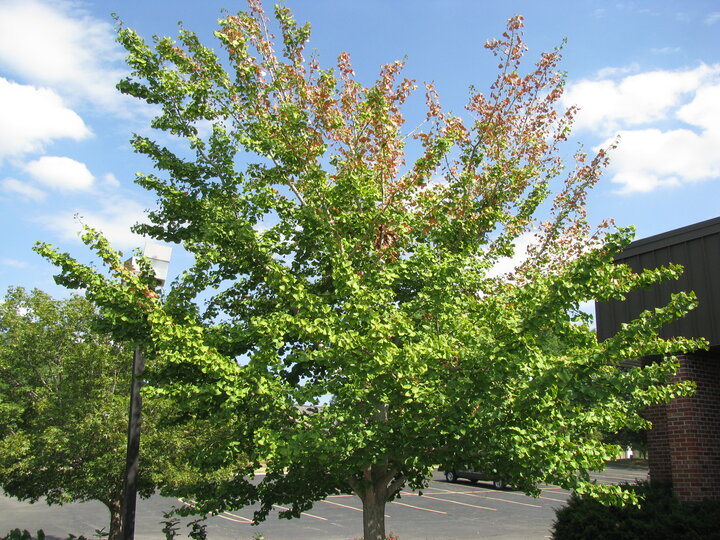
Photo of Drought Damage above is from John Fech, Nebraska Extension
Precipitation in May-July
40-50% of Annual Precipitation Falls
Wettest 3-month period
Source: Applied Climate Information System
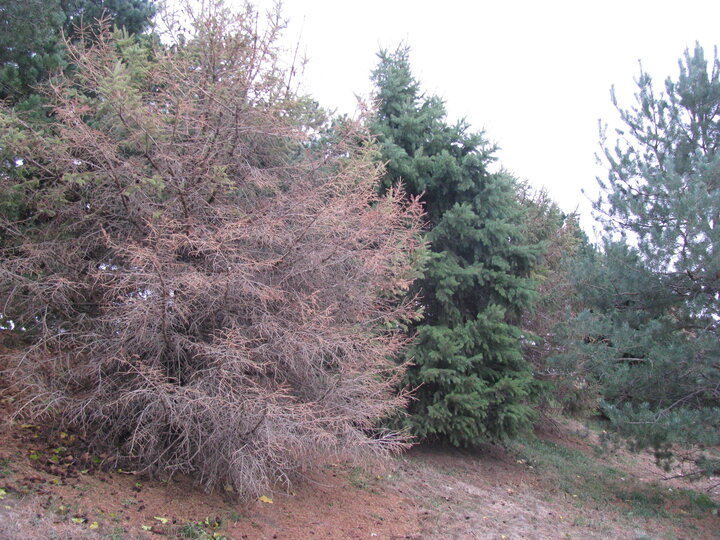
Photo of Drought Damage above is from John Fech, Nebraska Extension
Precipitation in April-September
70-80% of Annual Precipitation falls
Source: Applied Climate Information System
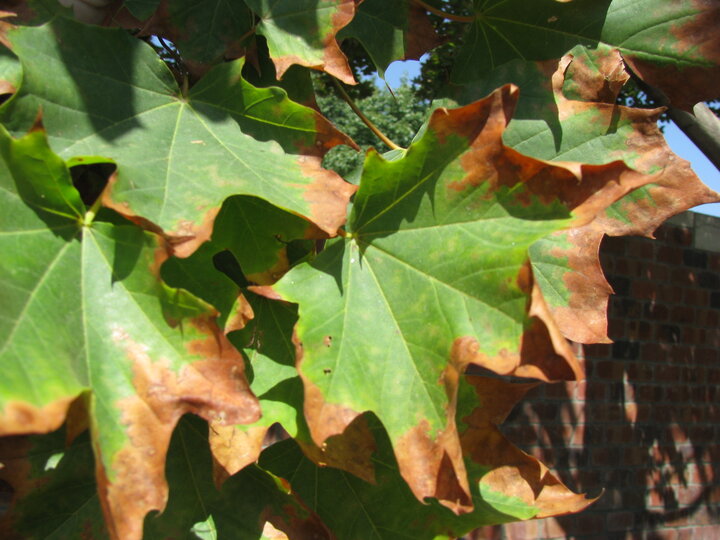
Photo above of drought damage on a maple leaf is from John Fech, Nebraska Extension
Corrective Actions
Corrective Actions
Recovery from drought is difficult and may take some time.
- Examine bark, buds, stems to determine if tissues are dried out. Prune out desiccated and dried out portions of the tree/shrub.
- Keep soil moist, not soggy or dry, for the growing season.
- Avoid fertilization in first year after drought.
- Mulch with wood chips to avoid weed competition and to moderate soil temperature and moisture. Avoid placement of mulch next to the trunk to prevent suffocation and wildlife damage.