Content
Seasonal information for Nebraska's green industry professionals.
Going In-depth
1. Inspecting for Decay - Decay threatens the structural stability of a shade tree. How can we monitor for decay and minimize negative consequences of tree decay?
2. September 30th growing degree days (GDD) - Several Nebraska sites below, Understanding Growing Degree Days
3. Pest update - Based on growing degree day (GDD) markers, the pest control season is at an end. Watch for the return of GDD pest target timing in March 2027.
Research You Can Use
4. Lilac Problems, What is causing your clients lilacs to look so bad and maybe even bloom this fall?
Greener Landscapes - Conservation & Climate Change Mitigation in Action
5. Planting for Fall Color - What makes good fall color in trees and shrubs and what plant species can you suggest to your clients who want good fall color in their landscape?
Timely Topics
6. Fall Flower Garden Activities
7. Aerate Lawns in Fall
8. Weather Ready Landscapes
9. Nuisance Home Invaders
For Your Information
10. Commercial/Non-commercial pesticide applicator certification - Obtaining a new license or updating an expired license.
11. Digital Diagnostic Network - Need help with diagnostics? - Submit pictures and questions for diagnosis by Nebraska Extension experts.
ProHort Update Newsletter
ProHort Update is a FREE monthly e-mail newsletter from Nebraska Extension, providing timely information to green industry professionals.
SubscribeNebraska's drought status, 10/1/2026

ProHort Update Body 10/2024
Upcoming Events
1. Inspecting for Decay
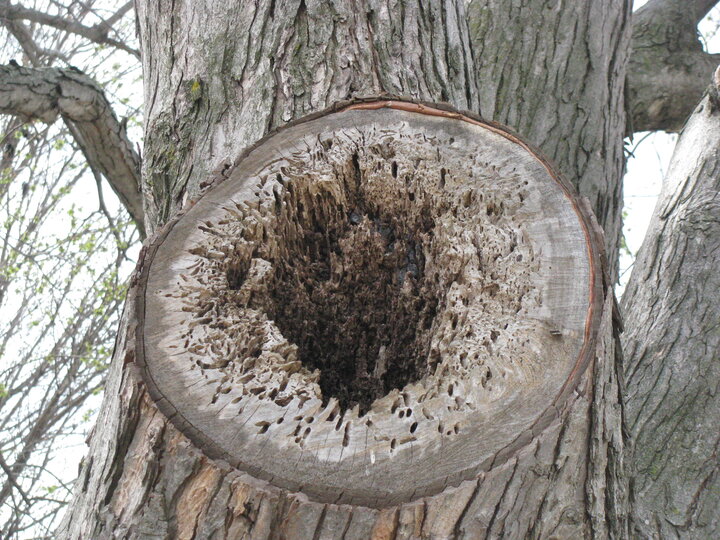
Big trees can be a great asset to a residential landscape, campus grounds or a sports field facility. Their provision of shade and stateliness is hard to beat. However, big trees with extensive decay are not an asset; they contain a defect that could be a ticking time bomb. Decay threatens the structural stability of a shade tree like termites jeopardize a house. Read on to learn how to spot it, how to estimate how much is there and what to do about it.
What is It?
Decay is the result of pathogenic fungi activity, working to soften tree tissues, causing loss in structural capacity of tree trunks and limbs. Decay fungi reduce wood strength and may kill storage and conductive tissues in the sapwood. As they infect a tree, these fungi degrade the cell wall components, most notably the lignin, cellulose and hemicellulose. While almost all species of woody plants can be affected by decay, older, weaker or stressed trees are most susceptible.
There are many specific pathogens such as white rot and brown rot, but all produce the same results. Some decay species affect mostly sapwood and conductive vessels, while others are active in the heartwood.
Consequences of Decay
Decay is not only a biological phenomenon. It also has potential ramifications for a location where people gather. The most common consequence is when a tree branch or whole tree falls onto a target – a person or valuable piece of property (truck, grandstand, building, fence, bench) – causing injury or damage that needs to be repaired or replaced. At first glance, decay can be a bit of a puzzle, but after further investigation, it becomes obvious that trunks and limbs become unable to support their own weight and fall downwards, especially in wind and rainstorms.
How to Spot It
Noticing decay symptoms is the first step in addressing the defect and determining if the tree in which is found is hazardous or relatively sound in the short term. Fruiting structures that form on trunks, root plates, roots and branches are the most obvious indicator that decay is present in a tree. Called mushrooms, brackets or conks, outgrowths of decay tissue that break through the bark are readily visible to the naked eye. They take on various shapes, sizes and colors and are often considered to be quite decorative, however, like the tip of an iceberg, they are a sign that there is a much larger concern inside the tree and/or tree part. Some structures are produced annually, while others grow for 2 or more years, adding additional tissue as time goes on.
Conks, mushrooms and brackets are not always present when decay organisms infect a tree. If they are not visible, it’s wise to look for other signs and symptoms such as surface sponginess in locations such as where limbs were previously removed, frost cracks, lightening injury spots and damaged areas from mowers or string trimmers at the base/root plate of the tree.
Decay is often hidden by intact bark, sometimes necessitating inspection by an experienced arborist to spot it. Sounding, drilling and probing are techniques that can be helpful in this regard. In addition to the loss of integrity in the short term, the seriousness of the malady is that there is no way to lessen the effects in the long term, other than to notify stakeholders of the seriousness of the defect.
Inspections, Monitoring
The solution to preventing damage to targets and perhaps more importantly, lawsuits is regular inspection. The first step is training all staff members on how to spot it in the landscape. The second is to investigate any suspicious wounds or trunk/branch areas that don’t look normal.
Inspection can be performed as a part of a regular scouting program by all staff or by dedicating a few people to regularly looking closely at signs and symptoms as part of their weekly routine. Whichever approach works best at your local facility/company, keeping simple notes on the status of each tree helps greatly with investigating possible decay.
How to Determine How Extensive it Is
Once an inspection and monitoring routine is set up, it’s important to implement some key techniques for decay detection. The most basic and often most helpful is to use a simple probing with a screwdriver technique. As simple as it sounds, pushing a standard or Phillips screwdriver against any area that looks soft or punky and seeing how far it can be pushed into the bark or sapwood is very telling in terms of whether decay is present.
How much is too much? It depends. If it’s a big tree and a screwdriver can be pushed in an inch or two, it’s probably not a significant amount of decay. However, if it can be pushed in 6 inches or more, then it should be evaluated with the overall diameter of the branch or trunk in mind. Some arborists are comfortable with the probe extending into the tree’s heartwood halfway, while others get alarmed if it goes in a fifth or a fourth of the way. Many arborists use a third as a standard, however, all, especially those with Tree Risk Assessment Qualification (TRAQ) credentials take many other factors such as the ratio of soft wood in the sapwood to heartwood, proximity to targets, the presence of other pests, the age of the tree, the softness of the wood related to species and any abiotic factors involved such as cracks, leaning and co-dominant leaders.
In addition to testing with a screwdriver, probing with a small diameter drill can also prove to be insightful. Of course, a drill bit can create or enlarge a wound on its own, but investigation of this type is usually worthwhile in terms of the information learned. If the tree is especially important because of historical significance, testing can be done by a Certified Arborist using a resistograph tool, ground detecting radar or sonic tomography.
The technique of “sounding” can be utilized, but it’s generally considered to be a tricky one to use. It involves using a rubber mallet being struck against the suspected area of decay and listening to the sound that occurs after striking. In many cases, the sound is described as a “thud’ or a “hollow echo”. At best, sounding is a subjective determination and never used alone when attempting to determine if decay is present.
Negligence
As you’re reading this article, you might be pondering whether regular inspection is really necessary. After all, if a branch falls off or a tree falls over, we’ll probably just clean it up and go about our routine with a half day delay. Unfortunately, that would be the best-case scenario. What happens if a heavy tree part falls on a house, car, maintenance shed or pump house – or worse, on a spectator, student or athlete? When a tree fails with the result of striking a target, the word negligence enters the picture.
What does negligence actually mean? There are several definitions, but the most pertinent is that as a professional horticulturist, you have a responsibility to care for the facility/property in a responsible manner. Doing so involves preventing injuries due to influences such as trip hazards, excessive turf slippage and yes, trees falling onto targets. Basically, if something bad happens and you didn’t take reasonable steps to prevent it, you’re negligent.
The good news is that negligence can be greatly minimized by taking prudent steps to properly manage trees. Hiring an ISA Certified Arborist to inspect trees that you have flagged in your regular inspections is a very responsible action that would be favorably viewed by the courts in a legal proceeding. Being upfront and honest with your insurance agent and facility risk management people is another.
What to Do About It
Unfortunately, there is no cure or treatment for decay. It would be great if trunks and branches could be injected with a fungicide or at least a fungistat to control or stop the spread of the fungus. Alas, this is not the case.
Even though there isn’t a product related treatment, at least 3 steps can be done to minimize negative consequences of tree decay.
- Evaluate and judge the threat of tree failure. Once decay is spotted, determining how advanced each incident is and estimating the potential negative outcomes would be is a good first step in management.
- Prioritize removal and remediation based on the present and the future function/aesthetics of the tree. Each tree in the landscape has a different level of importance in terms of the benefits it provides and the risks it poses.
- Try to prevent it in the future, using good pruning cuts, choosing decay resistant tree species and avoid mower blight when maintaining the turf growing close to tree trunks.
2. September 30th growing degree days (GDD)
| Location | Accumulated Growing Degree Days |
| Grand Island, NE - Airport | 3683 |
| Lincoln, NE - Airport | 3939 |
| Omaha, NE - Airport | 3988 |
| Norfolk, NE - Airport | 3440 |
| North Platte, NE - Airport | 3369 |
| Scottsbluff, NE - Airport | 3372 |
4. Lilac Problems, University of Illinois Extension
The lilacs are dealing with multiple disease issues this year and some have even thrown a few random blooms. Outside of powdery mildew that is seen often, we have seen a lot of Pseudocercospora (fungal) and Pseudomonas sp. (bacteria) leaf spots the last few years. How do you tell the difference between them? A lab test is needed to know for sure which disease is present and the UNL Plant & Diagnostic Clinic can determine the difference. Most lilacs will recover next year. Improving the plant health can also help reduce the issue.
Illinois Extension has a nice blog post about what can be done here.
5. Planting for Fall Color
Fall color can differ greatly from year to year depending on the weather, but there are plants to add to landscapes to give us reliable fall color, even in the years with less color variation or less intense fall colors.
How Fall Color Develops in our Trees
The color in our trees is due to four different pigments in the leaves: chlorophyll, carotene, tannin and anthocyanin. During the spring and summer, chlorophyll is the primary pigment in leaves. It is constantly being generated by the trees as it is easily broken down by bright sunlight. When this compound is being produced in the spring and summer, it is the most prevalent and that is why we see the green in the leaves. As the nights get cooler and the days get shorter, the tree produces a membrane between the branches and the leaves, causing them to no longer receive any chlorophyll that the tree might still be producing. This membrane also leads to the eventual shedding of the leaves in the fall. At this time, the other pigments show up in the leaves.
The brightest fall colors are produced when dry, sunny days are followed by cool, dry nights. The dry, sunny days are needed to break-down the chlorophyll in the leaves allowing the other pigments to be dominant. The cool, dry nights are also necessary to avoid freezing temperatures which can injure or kill the leaves causing them to stop producing much sugar at all. The sugar content is what increases the amount of the anthocyanin, or red pigment. The yellow and brown will be present, but the red is necessary as well.
Carotene
Carotene is the pigment that is responsible for yellow and orange colored leaves. Carotene is always in the leaves, as it aids in the capture of sunlight for photosynthesis, but it is at a lower amount than chlorophyll so green leaves appear.
Trees with high carotene in the fall for yellow or orange color include Shagbark Hickory as well as other hickories, birch, Redbud, and sugar maple. Serviceberry varies from yellow to orange to red. For shrub selections, choose witchhazel or spicebush.
Anthocyanin
Anthocyanin is the pigment that is responsible for pink, red, and purple leaves. This pigment is usually not present in the leaves until the fall. Some trees have red or purple colored leaves during the entire growing season because they have higher amounts of anthocyanins than chlorophyll throughout the whole growing season. Other trees don’t produce any anthocyanins and those are the trees that turn yellow, orange, or brown during the fall. Those trees and shrubs that turn red in the fall form anthocyanins when the concentration of sugar in the leaf increases. Low temperatures and bright sunshine destroys chlorophyll and when the temperatures stay above freezing during this time, anthocyanins are produced.
Trees with good red colors in the fall include scarlet oak, red maple, mountain ash, and sweetgum. For shrub selections, red fall color is found in burning bush, sumac, and some viburnums.
Tannins
Tannins make brown colored leaves. Tannins are always present in leaves but are not shown until the other pigments have dissipated from the leaves. These often accumulate in dead leaves, which is why dead areas of our leaves turn brown in color. Brown is a good color for our fall color palette and should not be overlooked.
6. Fall Flower Garden Activities
Inspect perennial gardens for dying plants and weeds. Remove these to improve the health of the plants that remain. Remove faded flower stalks and dig and divide crowded plants.
Scout landscapes for good locations to plant spring flowering bulbs. Loosen the soil and work in an inch of compost if the area does not drain well. The optimal planting time is late September and early October.
7. Aerate Lawns in Fall
If a client’s lawn drains poorly, aerate to increase air intake and increase rooting. Light fertilization after aeration enhances root regrowth and expansion. At this time of year, use mostly quick release nitrogen to ensure uptake and discourage downward movement and volatilization.
8. Weather Ready Landscapes
Focus tree pruning efforts on correcting storm damage and significant flaws in the canopy. Plan most corrective pruning action for late March and early April.
For more information on dealing with recent floods and how to help plants in your landscape recover, as well as information on many other natural disasters and how to prepare your landscapes for them, view our Weather Ready Landscapes resources.
Weather-ready landscapes are designed to withstand the weather extremes common in Nebraska, such as heavy rainfall, drought, extreme temperatures, and high winds. Key features of a weather-ready landscape include the following.
- Increased plant diversity and use of well-adapted plant species
- Use of landscape design principles to increase plant health and water use efficiency, and reduce fire risk
- Management of soil quality
- Use of water conservation techniques, including the use of rain gardens
- Proper landscape water drainage
- Establishment and management of effective windbreaks
By integrating these elements, a weather-ready landscape can better cope with the challenges posed by changing weather patterns and contribute to overall environmental health.
9. Nuisance Home Invaders
These pests may enter homes in fall as temperatures cool and they begin to look for overwintering sites. Pests like boxelder bugs, millipedes and Asian lady beetles are common. Most are harmless but still a nuisance.
Exclusion is the best means of reducing nuisance pests and mice indoors. Caulk cracks, crevices and conduits of the home. Repair window screens and check that doors are tight fitting. If needed, insecticides can be applied to building foundations according to label direction. Ideally, apply the insecticide from the foundation out to five to 10 feet.
Incidental Invaders, Nebraska Extension
Fall Invaders, Nebraska Extension
Controlling House Mice, Nebraska Extension
Identification Guide to Common Spiders in Nebraska, Nebraska Extension
10. Commercial/Non-commercial pesticide applicators
If you have a pesticide applicators license which expired in April 2026 or you need to get a new license, testing options are listed below.
Testing-only Options
- Closed-book exams are given by the Nebraska Department of Agriculture (NDA). Preregistration is not required an there is no cost. Visit the link below for a list of available test-only dates, times and locations - https://pested.unl.edu/.
- NDA computer-based testing is provided through the Pearson-Vue company. Click here for a list of testing sites, categories available, dates, and registration information. Cost $55 per exam. (For applicators with multiple categories on their license, each category is charged the full testing fee.)
Commercial/noncommercial applicators are professionals who apply restricted-use pesticides for hire or compensation. Anyone who applies pesticides to the property of another person, either restricted- or general-use products, for control of pests in lawns, landscapes, buildings or homes must also have a commercial pesticide applicators license. Public employees (those employed by a town, county, state) applying mosquito control pesticides whether restricted- or general-use, must also hold a commercial or noncommercial certification.
11. Digital Diagnostic Network - Need help with diagnostics?
Do you or your clients have questions you need help answering? Maybe you are a lawn care person and they're asking about trees, shrubs, or flowers? While you can refer them to their local Extension office, another option is Digital Diagnostic Network. Homeowners, lawn care professionals, pest control operators and others are invited to submit questions and photos through this website or with the assistance from an Extension professional at any Nebraska Extension office. All offices are equipped with high-resolution digital image capturing technology. Whether the question is about a lawn weed, insects on a plant, diseases in a shrub border or other, an expert panel of Extension professionals will review and respond to the question. To get started, create an account so the question can be reviewed and responded to via email. For more information and to create an account, go to Digital Diagnostic Network.
Bugging Out With Your Camera Phone - Tips on how to get a good picture.
Reference to commercial products or trade names is made with the understanding that no discrimination is intended and no endorsement by Nebraska Extension is implied. Use of commercial and trade names does not imply approval or constitute endorsement by Nebraskas Extension. Nor does it imply discrimination against other similar products.
Continuing Issues
Fruits & Vegetables
Trees & Shrubs
- Emerald Ash Borer Resources - EAB has been found in several Nebraska locations. Homeowners are encouraged to wait to begin treating their ash trees until the insect is confirmed within 15 miles of their location.
- NFS Tree Storm Damage Resources