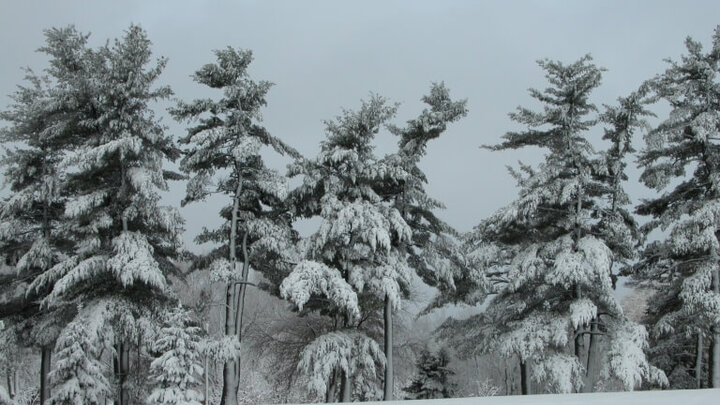
When snow or ice gathers on branches, stems, and crowns it can harm or kill plants. The amount of ice or heavy snow, the temperature, and the wind all play a role in the extent of the damage, but there are ways to correct and prevent damage.
Corrective Actions
When snow or ice forms on trees or shrubs it can cause branches to bend and sometimes break, but there are actions to take to reduce injury to yourself and the plant.
- Allow ice to melt off the plant naturally, it can break or crack branches.
- Do not stand under trees that are covered with ice, falling ice could be a hazard.
- Once the ice has melted and it is safe to be under the tree again, make corrective pruning cuts of broken branches. Remove trees that have been uprooted, have trunk failure, or more than 50% of branches are broken. You may need to consult or hire an arborist to assess your tree and to complete necessary pruning.
- Avoid foot or vehicle traffic across ice covered turf which can cause ice crystals on plants to fracture and damage plant tissue resulting in footprints, pathways or tire tracks across the turf that do not recover until late spring.
Deicers
Deicing salts melt ice and give people and vehicles traction, but they can be harmful to plants when piled around them. Sodium found in deicing salts can damage soil making it difficult for roots to absorb water or cause a crust to form on the soil surface preventing water from infiltrating soil. This can cause desiccation or drying out of the plant material, yellow or brown spots, stunted growth, dead patches in the lawn, branch dieback, or leaf tip burn. Plant damage from deicers doesn’t show up until spring when plants that were injured by deicing salts do not green up correctly.
When using deicers, try products that are less harmful to plants. Sodium chloride is frequently used. This product is inexpensive and easy to find, but quite harmful to plants. Products such as calcium chloride or calcium magnesium acetate are less harmful to plants. Apply a light layer of deicing salts in combination with gravel to get traction while using less deicing salt. Also, avoid piling snow in the same location each time to reduce the amount of sodium found around individual plants.
Plant Care After Ice
Maintain good irrigation when rainfall is not present. Keep soils around the plant evenly moist, not soggy and not dry. Water trees monthly during the winter when snowfall isn’t present. Irrigate using a sprinkler or hose on slow trickle in the drip zone of the tree to water to 12-18 inches deep for trees and 8-12 inches for shrubs. Test for soil moisture with a screwdriver prior to watering to determine if watering is needed. If the screwdriver goes into the soil easily, watering is not necessary. However, if pushing the screwdriver into the soil is very difficult or dry when it is removed, plants should be watered. Always remember to unhook hoses from the house after irrigation in winter months.
Maintain organic mulch around all trees and shrubs to reduce weed competition, moderate soil temperatures, and maintain moisture levels. Mulch should be a uniform 2-3 inches in depth throughout, do not mound mulches around the base of the plant.
Avoid fertilizing plants injured from snow and ice damage until the plant recovers. Fertilizers can push plant growth and burn plant roots which can cause more stress after snow or ice injury.
Preventative Actions
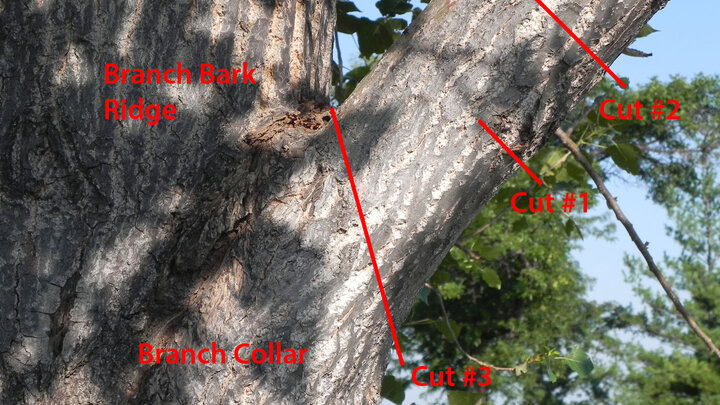
It is better to prevent tree injury before snow or ice damage occurs by maintaining correctly pruned trees. Always follow recommended pruning practices from the University of Nebraska, Nebraska Arborists Association, and the International Society of Arboriculture.
- Prune trees correctly when young to develop strong branching patterns and to avoid decay from removing large branches.
- Avoid topping, rounding off or pollarding pruning on trees which can result in weakly attached sucker branches that break easily in storms.
- Correctly remove dead, damaged, or diseased branches.
- Do not allow codominant trunks to develop which break easily with heavy snow and ice load.
- Select trees with dense wood and strong branch angles that are less susceptible to breakage.
- When staking trees, stake loosely, avoid staking trees too high on the trunk, and remove staking materials after one year.
- Monitor trees for signs of decay or other injury, look for fungal growth on bark, discolored wood, and large wounds.
Think ahead and maintain properly planted and pruned trees and shrubs to avoid damage from ice and snow.
This article was reviewed by John Fech, Extension Educator.